

Current Programmes
Dancing with the Prince of Orange
Court, Faith and Revolt in 11 Voices
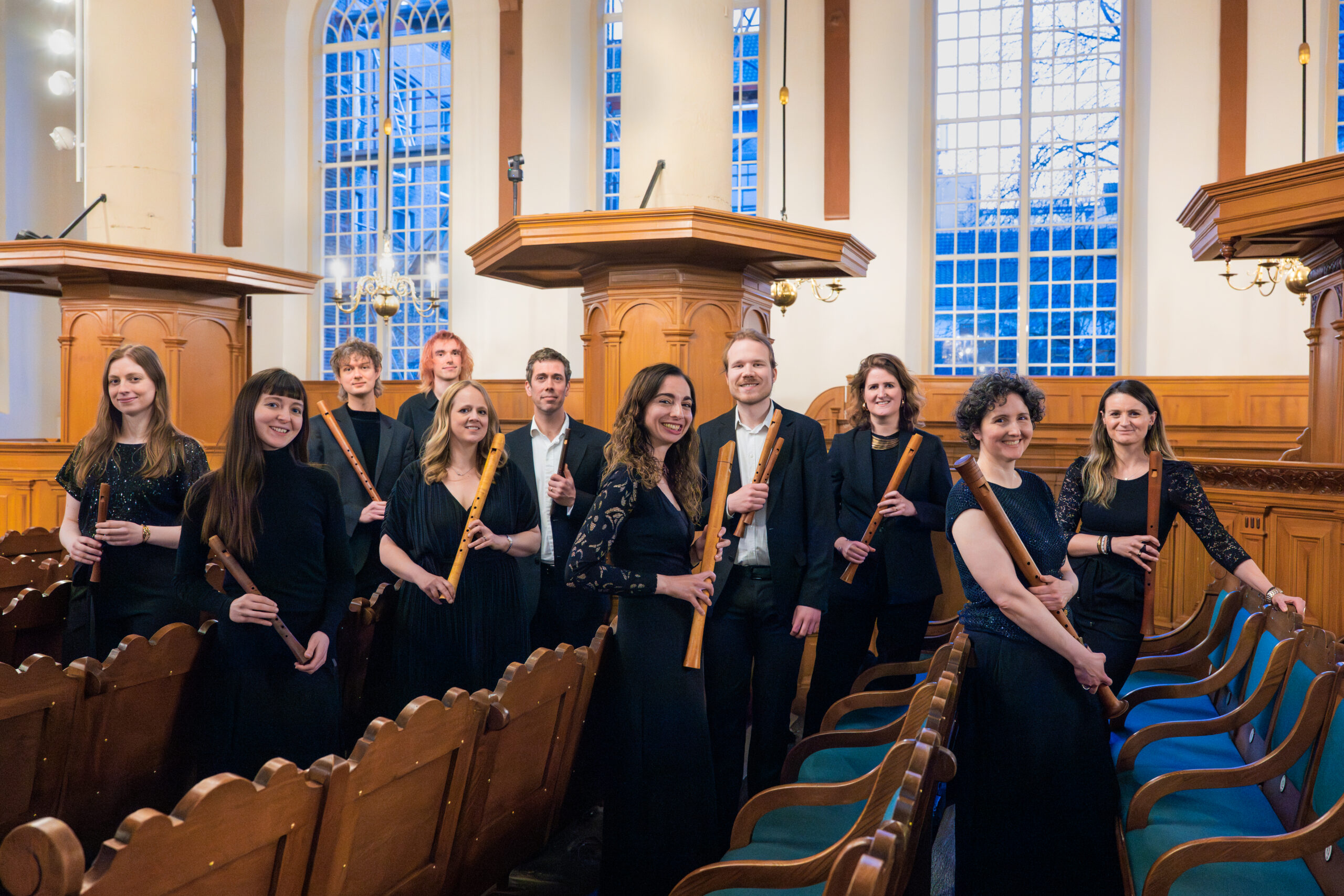
What did the world of William of Orange sound like? Known as William the Silent and remembered as the Father of the Dutch Republic, he lived in a time of religious upheaval, political conflict, and profound cultural change. What music accompanied life at court, resonated in churches, or was sung in the streets during these turbulent years? In Dancing with William of Orange, The Royal Wind Music brings the sixteenth century to life in a captivating musical performance filled with contrasts, movement, and stories.
Through music by composers including Nicolas Gombert, Orlando di Lasso, Ludwig Senfl, Jacob Clemens non Papa, and Jan Pieterszoon Sweelinck, the audience is guided through an era of profound change. Refined courtly music and exuberant dances give way to religious reflection, political unrest, and the emergence of new ideas. Music proves to be far more than entertainment: it connects, persuades, comforts, and inspires people to action.
A central thread throughout the programme is the Wilhelmus, which originated during William’s own lifetime. This famous melody reappears in various forms: recognizable, yet constantly transformed. The programme also features Geuzen songs from the time of the Revolt and the new work REVOLTE, in which past and present meet. With eleven recorder players, joined by voice and percussion, The Royal Wind Music creates a remarkably rich and varied sound world. Intimate moments alternate with festive dances, improvisation, and theatrical elements, resulting in a vibrant performance where the boundaries between concert, history, and experience begin to blur.
Dancing with William of Orange invites audiences to move through an age of faith, conflict, ideals, and change—and to discover how powerfully these stories still resonate today.
Programme and arrangements: Hester Groenleer
Available from November 2027
Lamentation & Celebration
A Musical Journey Through Melodic Transformation and Innovation
Step into the world of Renaissance music, where melodies traveled across courts and churches, inspiring innovation and transformation. In the sixteenth and early seventeenth centuries, secular chansons and madrigals were often reimagined as parody masses, turning familiar polyphonic works into striking new creations.
A celebrated example is Josquin des Prez’s Mille Regretz, admired by King Charles I of Spain, which inspired reworkings by Morales, Gombert, and vihuela virtuoso Luis de Narváez. These melodies also circulated through oral traditions, with diminutions and improvisations by composers such as Rognoni and Dalla Casa, reflecting a lively culture of spontaneous musical expression.
The Royal Wind Music brings these historical tunes to life alongside contemporary reflections: a commissioned work by Raivis Misjuns, improvisations inspired by Renaissance techniques, and the ensemble’s own diminutions on 16th-century madrigals. Music by Josquin, Cabezón, De Rore, Lassus, and others highlights the enduring power of imitation and variation.
Music by Josquin, Gombert, Lassus, Frescobaldi and others
Music by Josquin, Gombert, Lassus, Frescobaldi and others
Programme, arrangements and diminutions: Anna Stegmann
With thanks to the Cultuurfonds (Il Flauto Dolce Fonds, Tjarda Plevier-van Lier Fonds, Nora Baart Fonds), Amsterdams Fonds voor de Kunst, M.A.O.C. Gravin van Bylandt Stichting and Van Bijleveltstichting.
The Orpheus of Amsterdam
Celebrating the Music of Jan Pieterszoon Sweelinck
Jan Pieterszoon Sweelinck, celebrated as the ‘Orpheus of Amsterdam’, was an internationally renowned composer, organist, teacher, and expert in organ building. Living in Amsterdam from his boyhood, he played the organ in the Oude Kerk from around 1577 until his death. Sweelinck made significant contributions to both vocal and instrumental music, at a time when composers largely focused on vocal repertoire. While his vocal works were widely circulated thanks to the music printing industry, his keyboard music survived mainly in manuscript. Nonetheless, his exceptional teaching and compositions helped elevate the importance of instrumental music, laying the groundwork for its flourishing in the seventeenth century.
The Royal Wind Music brings Sweelinck’s music to life in a unique way, often compared to a walking organ, with the ensemble’s recorders evoking the sound of the Sweelinck-organ. Vocal works, including psalms, are optionally performed with a vocal quartet, creating a rich and immersive experience.
Released on Pan Classics in October 2024
Concept, programme, and arrangements: Hester Groenleer
11 recorder players and optional vocal quartet
Recent Programmes
Portrait of Albrecht Dürer
A musical biography of the master (1471–1528)
2021 marked the 550th anniversary of the birth of Albrecht Dürer, one of the leading artists of the Renaissance, following his steps from his birthplace Nuremberg to Italy and the Low Countries and playing music with a thematic connection to his drawings, paintings and engravings.
This programme will feature music associated with the court of the Holy Roman Emperor Maximilian I, Dürer's patron, and compositions published in Nuremberg and Venice. We also connect a few of his works, like Melencolia I, Praying Hands and his self-portraits to songs and motets which are as impressive and moving as Dürer's own works.
Programme, concept, arrangements and diminutions: María Martínez Ayerza
The Orange Tree Courtyard
Renaissance music in and around Seville Cathedral
Step into the serene world of Seville Cathedral, where Renaissance music resonates amid history and architecture. Built on the site of a former mosque, the cathedral of Santa María is one of Europe’s largest churches, with some elements of the mosque preserved, including the Patio de los Naranjos, a courtyard of orange trees.
The Royal Wind Music takes listeners on a musical stroll through the cathedral, passing: the altarpiece with a 13th-century image of Our Lady, Virgen de la Sede; a 16th-century lectern carved with an instrumental ensemble; the chapter house, where we encounter Francisco de Mudarra, priest and vihuela master; and the grave of Hernando de Colón, Columbus’ son and collector of music manuscripts.
The programme features sacred music by Francisco de Peñalosa, Pedro de Escobar, Cristóbal de Morales, Francisco Guerrero and Alonso Lobo, and secular music by Juan Vásquez, Miguel de Fuenllana and Alonso de Mudarra.
Released on Pan Classics, April 2023
Concept, programme, arrangements and diminutions: María Martínez Ayerza
Maarten Altena: Consort Music
A new contemporary composition alternating with a selection of Renaissance masterworks
The Royal Wind Music has inspired several contemporary composers. In 2012, the ensemble and organist Matthias Havinga premiered Ontkooid [Uncaged] for 13 small recorders and organ by Merlijn Twaalfhoven, commissioned with support from Orgelpark Amsterdam.
In 2013, the Dutch composer Maarten Altena composed a major new work for the ensemble. Consort Music, completed in 2014, lasts approximately 30 minutes and is divided into four parts. The work can be performed in its entirety, in separate sections, or combined with selections from other programmes, offering flexibility and dialogue between contemporary composition and Renaissance repertoire.
This programme highlights the ensemble’s commitment to bridging early music traditions with modern creativity, creating a compelling experience that celebrates both historical and contemporary musical worlds.
Altena describes his work:
In November 2012 I saw The Royal Wind Music on television, performing a dark and at the same time a clear and beautiful compoisition by Cyprien de Rore. The luminous zooming and the at times almost electronic sounds of the ensemble excited my imagination: perhaps I could also write something for The Royal Wind Music, with this “luminous zooming” as a point of departure.
Through our common friend Walter van Hauwe, I got to meet The Royal Wind Music and they asked me to write a piece for them. The result is Consort Music, a composition in four movements, in which monody plays an essential role. Various, continuously changing instruments play long melodic lines in unison. At times, as a consequence of accentuation, a kind of counterpart appears which sometimes lives a life of its own. And the zooming is taken very literally, as if an imaginary organ would start to whisper.